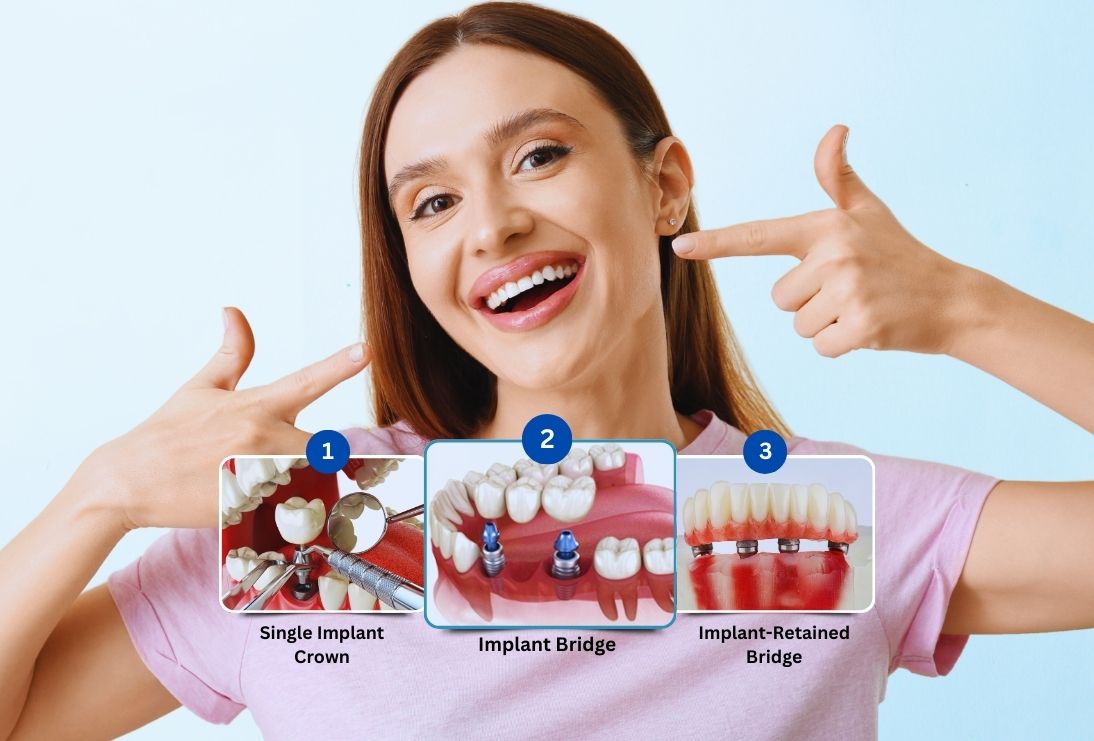
Dental implants have changed how missing teeth are replaced. Whether you’ve lost one tooth or several, implants can restore your smile with a look and feel that closely matches natural teeth. Understanding the main restoration types helps you ask better questions and choose the right plan with a specialist.
This guide covers three common options: Single Implant Crown, Implant Bridge, and Implant Retained Bridge.
What is a dental implant?
A dental implant is a small titanium post placed in the jawbone to replace the root of a missing tooth. Over time it fuses with the bone (osseointegration), creating a strong base for a crown, bridge, or other restoration.
Benefits often include better appearance, clearer speech, more comfort when chewing, and support for long-term oral health. For many people, implants are a durable long-term solution for tooth loss.
1. Single Implant Crown
A Single Implant Crown is the most common way to replace one missing tooth. One titanium implant is placed in the jawbone as a replacement root. A custom crown (a tooth-shaped cap) is then attached to restore appearance and function.
Benefits
- Natural look and feel — designed to blend with your existing teeth
- Protects neighboring teeth — unlike many traditional bridges, it usually doesn’t require grinding down healthy adjacent teeth
- Strength and durability — titanium provides a solid foundation; with good care, many implants last for decades
- Helps prevent bone loss — the implant stimulates the jawbone where the tooth was lost
Typical process
- Consultation — exam, imaging, and a personalized treatment plan
- Implant placement — the titanium post is placed in the jawbone (often under local anesthesia)
- Healing / osseointegration — several months for the implant to fuse with bone
- Abutment — a connector is attached to the implant
- Crown — a custom crown is attached to complete the smile
2. Implant Bridge
An Implant Bridge replaces several missing teeth in a row. Instead of relying on neighboring natural teeth for support (as a traditional bridge often does), the bridge is held by dental implants in the jawbone — typically two or more implants anchoring a span of replacement teeth.
Benefits
- Better function — a stable fit for eating, speaking, and smiling
- Natural aesthetics — custom shade, size, and shape to match nearby teeth
- Long-term option — durable when maintained well
- Bone support — implants help stimulate the jawbone under the restoration
Typical process
- Consultation — determine how many implants the gap and bone can support
- Implant placement — required implants are placed surgically
- Healing — osseointegration over several months
- Bridge attachment — the custom bridge of replacement teeth is secured to the implants
3. Implant Retained Bridge
An Implant Retained Bridge is similar to an implant bridge, but uses fewer implants to support a larger prosthetic. It can be a strong option when several teeth are missing and placing an implant for every tooth isn’t ideal — for example when bone volume is limited or when a more efficient plan is preferred.
Benefits
- Often more cost-efficient — fewer implants than replacing each tooth individually
- Stable and comfortable — firmly anchored so it doesn’t shift like some removable options
- Preserves jawbone — implants help stimulate bone and reduce deterioration
- Customizable — designed for your mouth, bite, and smile goals
Typical process
- Assessment — exam plus X-rays or 3D imaging to plan implant positions
- Strategic implant placement — a smaller number of implants placed for maximum support
- Healing — time for the implants to integrate with bone
- Bridge placement — the custom bridge is attached to restore function and appearance
Cost and what affects it
Implant costs vary. Common factors include:
- Type of restoration (single crown vs. bridge options)
- Number of implants needed
- Materials (for example, titanium posts and ceramic crowns)
- Location and specialist experience
- Extra steps such as bone grafting or sinus lifts when the jaw needs preparation
Upfront cost is often higher than some other tooth-replacement options, but durability and bone-preserving benefits make implants a strong long-term investment for many patients.
Choosing the right type
The best option depends on how many teeth are missing, bone density, overall oral health, bite, and budget. A qualified implant dentist can evaluate your case and recommend a Single Implant Crown, Implant Bridge, Implant Retained Bridge — or another plan such as full-arch options when appropriate.
Find a Houston implant specialist with Nuvi
Not sure which implant path fits you? Chat with Nuvi on houston.nuvidoc.com. Free matching helps you find a Houston implant dentist for your situation, and Nuvi can help book your consultation.